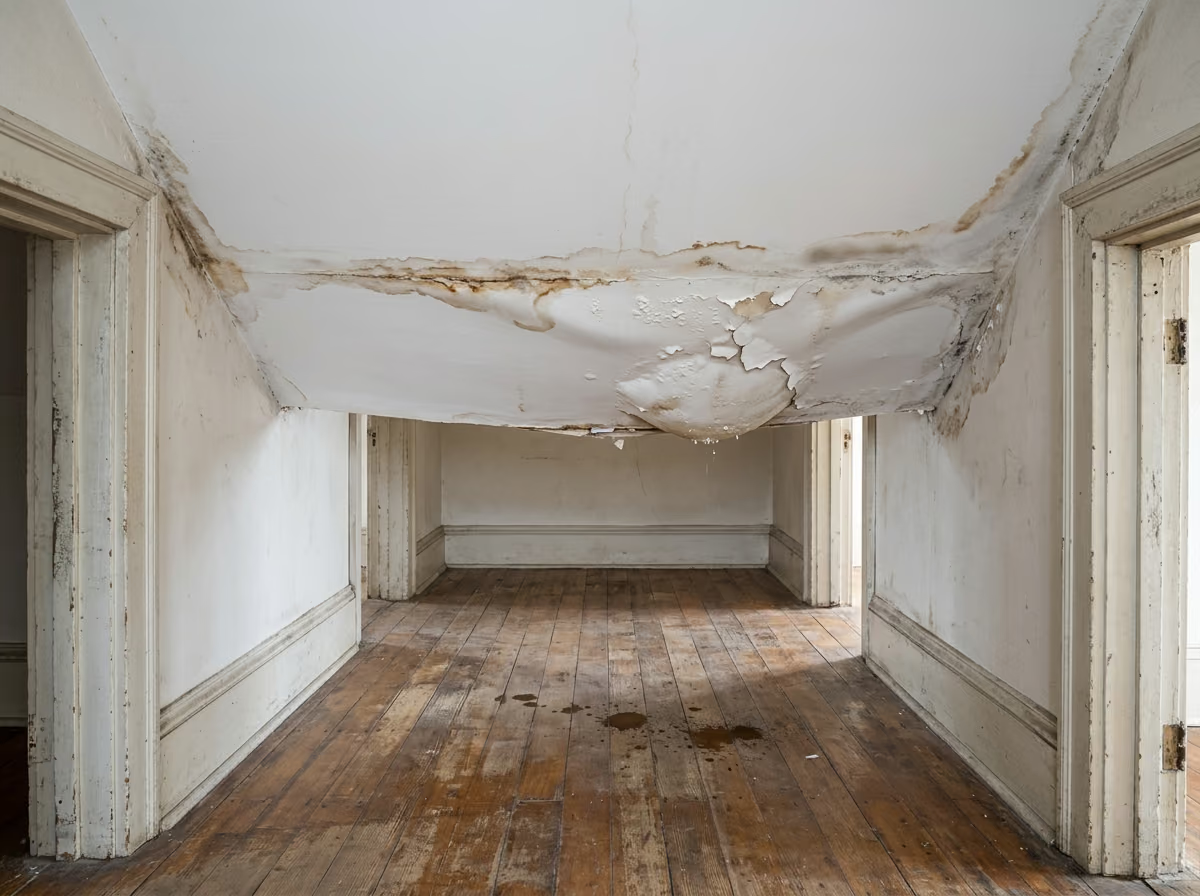
Water leaking through the ceiling: what to do now
Find the source above and stop it, then protect the room below. Do these in order.
- Stop the water. If a bathroom or appliance is above the ceiling, close its valve or shut the main. If it's raining in, the roof is the likely source.
- Stay out from under a sagging ceiling. Wet drywall gets heavy and can come down without warning.
- Make the electrical safe. If water is dripping near a light or fan, turn that circuit off at the breaker. Do this only if you can stand somewhere dry.
- Catch the water. Put buckets under drips, and move furniture and rugs out of the way.
- Take photos and video of the ceiling, the floor below and the source, before anything is moved.
- Call for help. A plumber or roofer fixes the source. A restoration company dries the ceiling, insulation and floor.
Should I poke a hole in a bulging ceiling?
It's safest not to stand under it. A ceiling holding water can drop all at once. Keep people and pets away, put a bucket below, and ask the restoration company on the call what to do.
Who do I call for a water leak in the ceiling?
Call whoever fixes the source: a plumber for pipes and fixtures, a roofer for rain. Call a restoration company to dry the ceiling cavity and anything below. See who to call for water damage.
Roof leaks in Bellingham rain
Roof leaks tend to show up once the rainy season starts. About half of Bellingham's yearly rain falls from October through January. November is Bellingham's wettest month, with 5.20 inches in a normal year at the airport (NOAA 1991–2020 normals). In September 2026, the airport got 4.02 inches, about twice normal (NOAA). Early storms like that find clogged gutters and worn flashing.

Windstorms add to it. The November 2024 "bomb cyclone" was felt across parts of Western Washington, including Sudden Valley (KPUG). Wind damage to a roof can let rain into the attic. The water soaks the insulation and then drips through the ceiling.
A roofer stops the water, often with a tarp first and a repair later. A restoration company dries the attic, ceiling and walls below. Get the roof covered quickly. In Washington, water damage caused by a delay in repairs usually isn't covered by insurance (WA OIC).
Water heater leaking from the bottom
A water heater leaking from the bottom can put a lot of water on the floor fast. The other risks are scalding water and, on a gas heater, the gas supply. Shut it down and stop the water, then call a plumber.
- Turn off the cold water supply to the tank.
- Turn off the power or gas to the water heater.
- If you smell gas, leave the house. Call 911 from outside, then the gas utility. In Bellingham, that's Cascade Natural Gas, whose 24-hour emergency line is 888-522-1130.
- Keep clear of hot water. The water in the tank and on the floor may be scalding.
Not every bottom leak means a dead tank. Water at the base can also come from loose connections, the relief valve or condensation, A.O. Smith's manual notes. A plumber can tell whether the tank itself has failed.
In Bellingham, a water heater replacement needs a City permit, which is applied for online (City of Bellingham eTRAKiT). Your plumber usually handles it.
Should I keep my water heater on while it's being removed?
No. Turn off the power or gas and the cold water supply before anyone drains or moves the tank.
Appliance and toilet leaks
Appliance and toilet leaks are some of the most common indoor water losses. Each one fails in its own way.

- Dishwasher. A dishwasher can overflow, or leak slowly underneath. Water can then sit under the dishwasher and the cabinets, out of sight.
- Washing machine. Rubber fill hoses can split. The OIC suggests braided stainless steel hoses, which last longer than rubber.
- Fridge and ice-maker line. A thin plastic or copper line runs behind the fridge. If it cracks, water can run under the flooring before anyone sees it.
- Toilet. A failed supply line can flood a bathroom quickly. A worn wax ring at the base leaks slowly into the subfloor and the ceiling below.
- Supply lines and pipes. Leaks inside walls can come from copper, PEX, CPVC or galvanized steel lines, often at a fitting or joint.
A toilet that runs or refills on its own may have a leak. The City of Bellingham gives utility customers free toilet leak detection tablets. Call (360) 778-7700 or email askpw@cob.org.
The OIC also suggests leak detectors near appliances and the water heater, and a drain pan under the water heater (WA OIC).
Who fixes the leak, and who dries the house?
Usually two different trades. A plumber fixes pipes, fixtures and water heaters. A roofer fixes roof leaks, and an appliance technician repairs appliances. A restoration company removes the water and dries the house.
Stop the source first. Drying can start while the repair is being scheduled, as long as the water is off. Don't close up walls or lay new floors until the materials read dry. See who to call for water damage and burst and frozen pipe water damage.
How a leak gets dried out
Here is the usual order on a leak job run by the restoration company your call is connected to. Ask to be shown what needs to come out, and why, before anything is removed.
- Find the source and confirm it's off.
- Moisture mapping. The crew uses moisture meters to trace where the water went inside walls, ceilings and floors.
- Water removal. Standing water is extracted. Wet carpet pad and soaked ceiling insulation usually come out.
- Open only what can't dry in place. Sometimes that's a strip of drywall or a cabinet toe-kick.
- Drying. Air movers and dehumidifiers run until materials match the reading of the same material in a dry room. That target is called the dry standard.
- Repairs. Drywall, paint, flooring and trim go back after drying. Ask whether the same company handles repairs.
See structural drying for how walls, floors and framing are dried and measured.
Does wet hardwood flooring have to be torn out after a leak?
Not always. Mildly cupped boards can often be saved by drying them first, then sanding and refinishing once they read dry. Sanding too early can cause new damage. Boards that stay wet too long, or that buckle badly, usually need replacing.
Will my cabinets and flooring be saved?
It depends on the material and how long it stayed wet. Some materials dry in place, and some swell and have to be replaced. Ask the company to show you moisture readings for each item, not just its opinion.
Found a stain, a soft wall or a musty smell? Call (360) 555-0123 to be connected with a local restoration company that can check it with a moisture meter.
Sudden leaks, slow leaks and insurance
Insurance usually covers a sudden leak but often not a slow one. The OIC's examples of covered leaks include a burst supply line, a snapped ice-maker line and a dishwasher overflow. Slow drips and leaks that build up over more than a couple of days usually aren't covered (WA OIC).
Report a leak to your insurer quickly, and take photos before cleanup. See does insurance cover water damage in Washington and insurance claim help.
How this site works
Bellingham Water Damage is a referral service run by Mateo. When you call, you're connected to a local water damage restoration company that serves your area. That company does the work, and we may receive a referral fee. Check the company on L&I Verify before work starts, and ask for a written estimate before non-emergency work. See about this site.
Common questions
What are the most common sources of water damage in a home?
Leaks from pipes, water heaters, dishwashers, washing machines, fridge lines, toilets and roofs. In Bellingham, frozen pipes add to that during winter cold snaps. See burst and frozen pipe water damage.
Do I need a professional if I already dried the leak with fans?
Maybe not, if the water stayed on the surface and dried fast. The EPA says wet materials dried within 24 to 48 hours usually won't grow mold. If water got under flooring or into a wall, a fan may not reach it. A moisture meter reading tells you for sure.
Is there water damage under my floor after a toilet leak?
Possibly. Water from a toilet base runs into the subfloor and can reach the ceiling below. Signs are a soft floor near the toilet, loose tiles or a stain underneath.
Can water damage be fixed before my home sale closes?
Often, if it's found early. Drying can take days, and repairs take longer. Ask the restoration company for photos, moisture readings and the final dry readings to share with the buyer.
What do I do when the condo above leaks into my ceiling?
Tell the upstairs owner and the HOA or property manager right away, and take photos. Report it to your own insurer too. The HOA policy and each unit owner's policy may each cover part of it. See does insurance cover water damage in Washington.
How do I dry out a room after a water leak?
Stop the water, then remove standing water and wet rugs. Run a dehumidifier with the windows closed, plus fans aimed at wet surfaces. If drywall, carpet pad or insulation got soaked, call a restoration company. See structural drying.