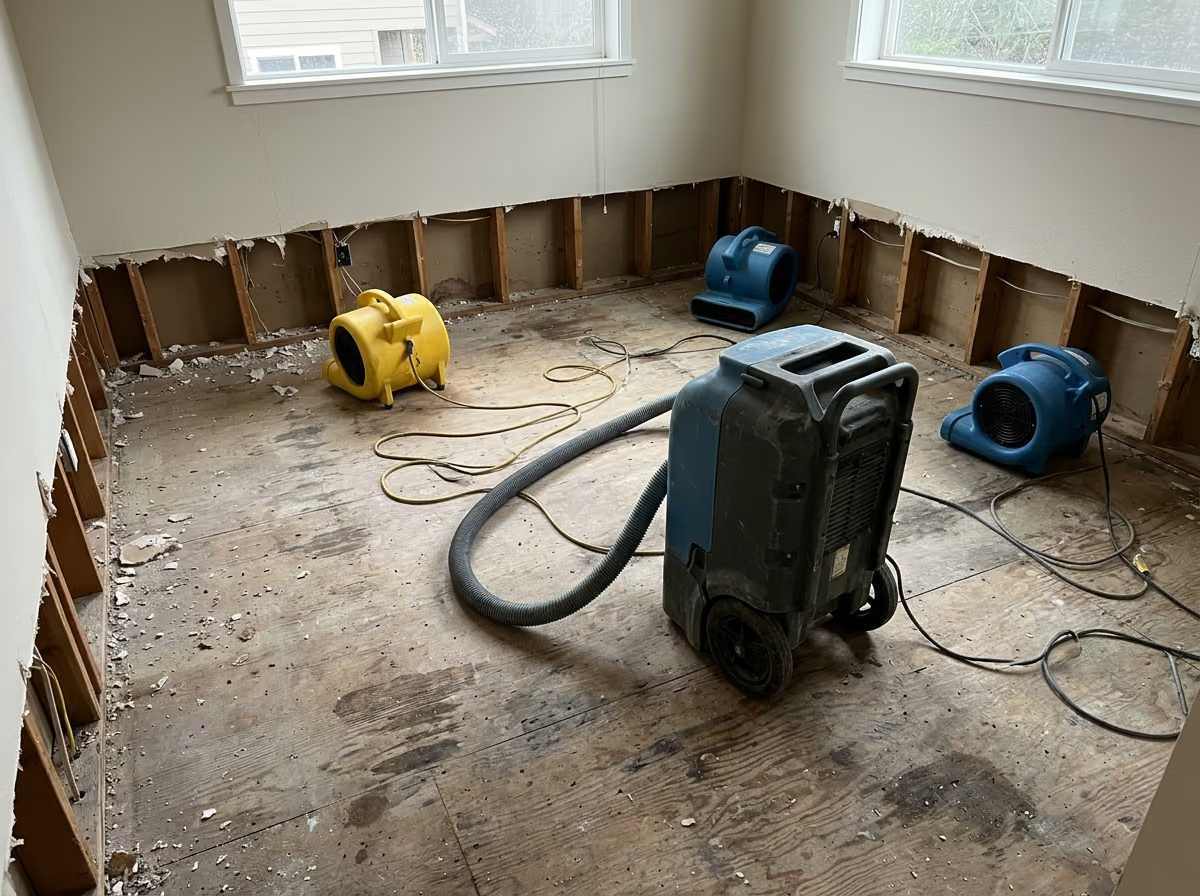
How does structural drying work?
Structural drying works in two moves. Fans pull water out of wet drywall, wood and concrete into the air. A dehumidifier then pulls that water out of the air so it can't soak back in.
Here is the usual order on a clean-water job:
- Stop the water. Nothing dries while the leak is still running.
- Measure. The crew maps the wet area with moisture meters and often a thermal camera.
- Remove standing water. Extractors pull water out of carpet and pad first. It's the fastest water to remove.
- Open only what can't dry in place. That may be a carpet pad, a cabinet toe-kick or a strip of drywall.
- Set the equipment. Air movers aim at wet walls and floors. Dehumidifiers run in the same closed space.
- Take readings until it's done. The crew re-checks the same spots and logs each reading.
The EPA says materials dried within 24 to 48 hours usually won't grow mold. For emergency steps before the crew arrives, see emergency water removal. For the full job from first call to rebuild, see the water damage restoration process.
How do you know it's dry? The dry standard
A material is dry when its moisture reading matches the same material in a part of the house the water never touched. That target is called the dry standard. A crew should set it on day one, before the equipment goes in.
A dry stud reads differently from dry drywall, so the crew compares wet drywall with dry drywall, and wet wood with dry wood.
NDSU Extension (2023) says wood should read below 15% moisture before drywall or paneling covers it. It also says a wood moisture meter is the only accurate test. Walls that feel dry to the touch can still be wet inside.
Moisture meters and thermal cameras
- Pin meter. Two small pins push into wood or drywall and read moisture at that depth. It leaves tiny holes.
- Pinless meter. A flat pad slides over the surface and reads a little way into the material. It's quick for scanning a wall.
- Thermal camera. It shows cool spots where water is evaporating. A cool spot is a clue, not proof, so the crew confirms it with a meter.
- Hygrometer. It reads air temperature and relative humidity (RH), the share of water the air is holding. These readings show whether the dehumidifiers are working.
A meter only reads the spot it touches. That is why crews check in a grid and re-check the same marked spots each day.
The drying log
A drying log is the daily record of readings, room conditions and equipment. It is the proof your adjuster uses to see why drying took as long as it did. See insurance claim help for what a good log includes and how to use it in a claim.
The drying equipment and what each piece does
- Air movers (fans). These high-speed fans blow air low across walls and floors. A snail-shaped centrifugal air mover aims a tight stream at a wall or ceiling. A drum-style axial air mover moves more air over a wide floor.
- LGR dehumidifier. LGR stands for low grain refrigerant. It's a commercial dehumidifier that keeps pulling water out of the air even as the air gets drier. It usually pumps the water to a sink or drain.
- Heat. Warm water evaporates faster. Crews may raise the room's temperature, so the house can feel warm while drying runs.
- Wall cavity drying systems. Small holes near the floor let a machine push warm, dry air inside a closed wall. This can save a wall that would otherwise be cut open.
- Hardwood floor drying mats. Flat mats seal onto the floor and pull water up through the seams between boards.
- Air scrubber. This machine filters dust and spores out of the air with a HEPA filter. It's mostly used when drywall is cut out, or after sewage or mold.

All of this equipment needs electricity, so ask how it will be powered if the house has no service. It's usually billed per machine, per day. See water damage restoration cost for how equipment days add up.
Why Bellingham's damp air changes how a house dries
In Bellingham's rainy season, opening the windows often won't dry the house. Outside air from October through March is often cool and damp. That's why crews keep the house closed and let dehumidifiers do the work.
November is Bellingham's wettest month, with 5.20 inches of rain at the airport in a normal year (NOAA 1991–2020 normals). NDSU Extension (2023) notes that a dehumidifier is the tool to use when the outside air is humid.
Crawl spaces are the hardest spots to dry here. They sit on damp soil, so moisture keeps rising into them. See crawl space water removal for how those are dried.
Once the job is done, keeping the house dry still matters. The EPA suggests keeping indoor humidity below 60%, and ideally between 30% and 50%.
Can it be saved? Drywall, insulation, carpet and floors
Whether a material can be saved depends on three things. These are the type of water, how long the material stayed wet, and whether it swelled or came apart. Clean water caught quickly gives you the best chance.
The EPA's water damage cleanup table, written for clean water, gives these starting points:
| Material | EPA guidance | What it means for you |
|---|---|---|
| Drywall (wallboard) | May be dried in place if there's no obvious swelling and the seams are intact. If not, remove and replace. | A flat wall with tight seams is often worth drying. |
| Fiberglass or cellulose insulation | Discard and replace. | Wet insulation inside a wall means that wall gets opened. |
| Carpet and backing | Extract the water, then dry with dehumidifiers and fans within 24 to 48 hours. | Clean-water carpet can often be saved if drying starts fast. |
| Ceiling tiles | Discard and replace. | Stained or sagging tiles don't come back. |
| Wood surfaces | Remove moisture right away, then dry with dehumidifiers, gentle heat and fans. | Framing and wood floors usually dry if work starts early. |
| Vinyl, tile and linoleum floors | Clean the surface, then make sure the underfloor is dry. | The floor may look fine while the subfloor stays wet. |
Source: EPA, Mold Remediation in Schools and Commercial Buildings, Table 1.
Sewage and river or creek floodwater change all of this. Porous materials that touched that water, such as carpet, pad, drywall and insulation, come out. See water damage categories for clean, gray and black water.
Not sure what can stay? Call (360) 555-0123. Ask the restoration company to show you moisture readings for each item before anything is removed.
Can wet walls be dried without tearing them out?
Often, yes. A wall with clean water, no insulation inside, no swelling and tight seams can usually be dried in place. Crews may pull the baseboard and drill small holes behind it. Then they push dry air into the wall cavity.
A wall usually has to be opened in these cases:
- The wall has insulation inside, and the insulation got wet.
- The drywall is swollen, crumbling or pulling off the screws.
- The water was sewage or river or creek floodwater.
- Readings stay high after a few days of drying.
When a wall is opened, the crew cuts a straight line above the highest wet reading. That is called a flood cut. Drywall wicks water upward, so the cut sits above the visible stain, not at it. The flooded basement page explains how flood cut height is chosen.
Unneeded demolition is a common complaint. Ask the company to show you the readings that justify each cut before it's made. Contaminated water is the exception, because that material comes out for safety.
Carpet and pad: dry it or replace it?
Carpet can often be dried and kept after a clean-water leak. The pad under it is a different story. Pad soaks up water like a sponge, so it is usually pulled out and replaced.
Here's how crews usually handle wet carpet:
- Extract first. A strong extractor pulls water out of carpet and pad before any fan runs.
- Pull the pad. The carpet is lifted back from the tack strip, and the wet pad is cut out.
- Float the carpet. An air mover blows air under the carpet so it dries from both sides.
- Re-stretch and re-pad. New pad goes in once the subfloor reads dry.
Carpet is usually replaced in these cases:
- The water was sewage, toilet overflow with waste, or river or creek floodwater.
- The carpet stayed wet for days before drying started.
- The backing has come apart from the carpet face. This is called delamination.
Wet basement carpet after heavy rain is common here. If the water came through the walls or floor, it may come back with the next storm. See flooded basement cleanup.
Hardwood, laminate and subfloors
Wet hardwood can often be saved if drying starts quickly. Boards that cup, with edges higher than the middle, often flatten as they dry. Floor drying mats pull water up through the seams between boards.

Sanding comes last. Boards should read dry before anyone sands or refinishes them. Sanding a floor that is still wet can leave it uneven once it finishes drying. The leak page has more on saving hardwood after a leak.
Laminate is harder to save. Its core is pressed wood fiber, and the edges swell when they soak up water. Swollen laminate planks usually get replaced. The crew then dries the subfloor underneath before new flooring goes down.
The subfloor is the wood layer under the finished floor. Water often hides there after a dishwasher, toilet or fridge-line leak. A meter reading on the subfloor tells you if the problem is bigger than the floor you can see.
What to ask the restoration company about drying
Ask these questions on the first day. The answers show whether drying is measured or guessed.
- What is the dry standard for each material? Ask where they took the dry reading.
- Where are the marked reading spots? The same spots should be checked each day.
- How many machines are in each room, and why? Equipment should match the wet area, not the size of the house.
- How often will someone check the readings? Ask who your contact is between visits.
- What has to come out, and what's the reading that shows it? Ask before any drywall, flooring or cabinets are removed.
- Will I get a copy of the drying log? Ask for it before the equipment leaves.
- Who handles repairs after drying? See how it works when you call.
Ask the company for a written estimate before any non-emergency work.
How this site works
Bellingham Water Damage is a referral service run by Mateo. When you call, you're connected to a local water damage restoration company that serves your area. That company does the drying work, and we may receive a referral fee. Check any company on L&I Verify before work starts.
Want wet walls or floors measured and dried? Call (360) 555-0123. Calls are answered 24/7 for Bellingham and all of Whatcom County.
Common questions
Dehumidifiers vs floor dryers: when do you use each?
You need both. Fans alone just move damp air around the room, so a dehumidifier has to remove the water they lift out.
Why does my house get so warm during drying?
Crews often add heat because warm water evaporates faster. Dehumidifiers also give off warm air as they run. Ask the crew what room temperature they're aiming for, and tell them about pets or people who can't handle heat.
Why are there so many fans in my house?
More wet area means more fans. Ask the company to explain the count room by room, and to remove equipment from rooms that read dry.
Do I need to open up vanities and cabinet kickboards so they dry?
Often, yes. Water runs under cabinets and gets trapped there. Crews usually pull the toe-kick, the thin board at the base, so air can reach the floor underneath. Cabinets themselves may not need to come out.
Can carpet padding be dried?
Sometimes, after a small clean-water leak caught quickly. In most cases the pad is pulled, because it holds water and is cheap to replace compared with the days of drying it needs.
Is mold a risk if drying takes too long?
Yes. If walls are closed up while still wet, mold can grow out of sight. See mold after water damage and mold remediation.